



Microsoft MAI-Thinking-1 represents a pivotal moment in enterprise AI. For the first time, Microsoft has built its own reasoning model entirely from scratch — no OpenAI distillation, no third-party training data, and no inherited intelligence. Announced at Build 2026 on June 2, this 35-billion-parameter model is the flagship of a new seven-model family that signals Microsoft’s growing independence in the AI race. Here is everything IT professionals and enterprise leaders need to know about Microsoft MAI-Thinking-1 and what it means for the Microsoft 365 ecosystem.
What Is Microsoft MAI-Thinking-1?
Microsoft MAI-Thinking-1 is a medium-sized reasoning model built by the Microsoft AI Superintelligence team. It uses a sparse Mixture of Experts (MoE) architecture with 35 billion active parameters drawn from roughly one trillion total parameters. Despite being smaller than many competing models, it delivers performance that matches or exceeds much larger alternatives on key benchmarks.
The model supports a 256K token context window, which is large enough to process approximately 600 pages of text in a single prompt. It also supports function calling, multi-layered instruction following, and is fully compatible with the widely used Chat Completions API. In addition, Microsoft designed MAI-Thinking-1 specifically for enterprise readiness, with built-in support for developer instructions and enterprise-grade security through Microsoft Foundry.

Why Microsoft MAI-Thinking-1 Matters for Enterprise
The significance of Microsoft MAI-Thinking-1 goes beyond raw benchmarks. This model marks Microsoft’s strategic shift toward AI self-sufficiency. Until now, Microsoft’s flagship AI experiences — from Copilot in Microsoft 365 to Azure OpenAI Service — relied heavily on OpenAI’s models. However, MAI-Thinking-1 was trained from scratch on clean, commercially licensed, enterprise-grade data without any distillation from OpenAI, Anthropic, or other third-party models.
For enterprise customers, this matters for several important reasons. First, data provenance becomes transparent and traceable, which helps organizations meet compliance and regulatory requirements. Second, Microsoft can now optimize its models end-to-end for its own product ecosystem, potentially leading to deeper integration with Microsoft 365, Azure, and the broader Microsoft stack. Third, reduced dependency on a single external AI provider strengthens Microsoft’s long-term competitive position and supply chain resilience.
Microsoft MAI-Thinking-1 Benchmark Performance
The benchmark results for Microsoft MAI-Thinking-1 are impressive for a model in its weight class. On the AIME 2025 mathematical reasoning benchmark, it scores 97.0%, and it achieves 94.5% on the more challenging AIME 2026 benchmark. These results demonstrate strong multi-step scientific and mathematical reasoning capabilities that were learned from the ground up, rather than inherited from another model.
On software engineering tasks, MAI-Thinking-1 scores 53% on SWE-Bench Pro, which puts it on par with Claude Opus 4.6 — a significantly larger model. Furthermore, in blind human side-by-side evaluations conducted with professional raters from Surge across 1,276 tasks, users preferred MAI-Thinking-1 over Claude Sonnet 4.6 for overall helpfulness and quality.
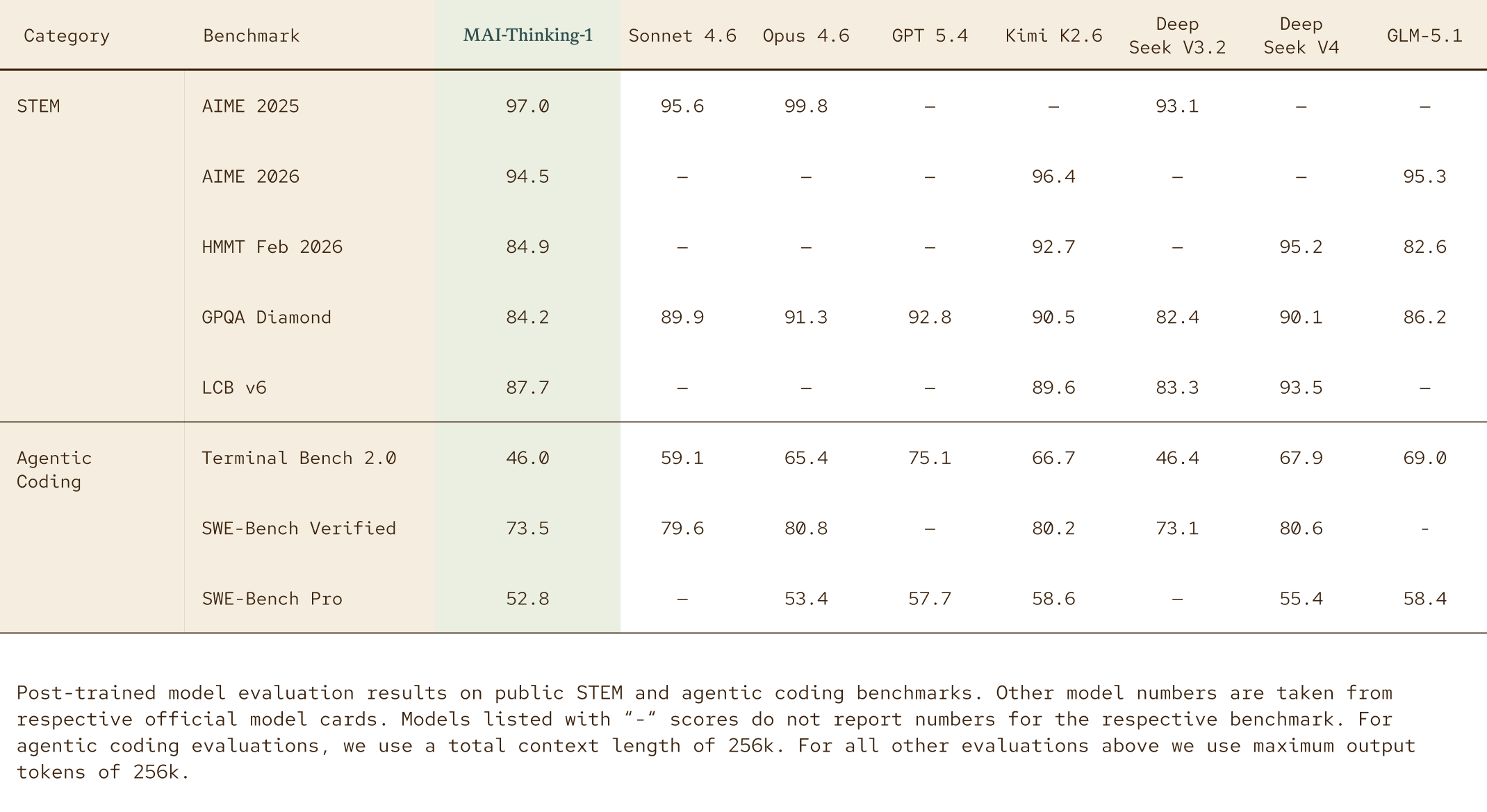
These numbers are especially notable because MAI-Thinking-1 has a much smaller inference footprint than its competitors. As a result, it can deliver competitive reasoning at a fraction of the cost, making high-volume and always-on AI workloads economically viable for enterprises.
The Hill-Climbing Machine Behind Microsoft MAI-Thinking-1
Microsoft describes its approach as a “Hill-Climbing Machine” — a co-designed pipeline built to make every component of model development continuously improvable. Rather than building a single model and moving on, Microsoft has created a repeatable system that can absorb better data, stronger rewards, more capable training environments, and additional compute over time.
Three core principles guide this philosophy. First, capabilities should be learned rather than inherited. Although distillation from a stronger model is faster, it limits steerability and adaptability. Second, clean data is essential. Microsoft trained MAI-Thinking-1 on traceable, enterprise-grade datasets, which means the company can fully account for what shaped the model’s behavior. Third, self-sufficiency across the entire stack — from custom accelerators to reinforcement learning frameworks — ensures Microsoft can optimize and iterate independently.
Additionally, Microsoft invested heavily in deterministic, executable training environments for agentic coding tasks. Each environment is graded by real test suites, giving the model practice on multi-step workflows that mirror actual developer work: reading code, editing files, running tests, observing failures, and recovering from mistakes.
The Complete MAI Model Family at Build 2026
Microsoft MAI-Thinking-1 is the flagship, but it launched alongside six other models that together form Microsoft’s first comprehensive in-house AI model family. Here is the complete lineup:
- MAI-Thinking-1 — The flagship reasoning model with 35B active parameters, 256K context window, and top-tier STEM and coding benchmarks.
- MAI-Thinking Mini — A smaller, faster variant of the thinking model for latency-sensitive applications.
- MAI-Code-1-Flash — An inference-efficient agentic coding model deeply integrated into GitHub Copilot and VS Code.
- MAI-Image-2.5 — A world-class text-to-image and image editing model that surpassed top Arena ELO scores.
- MAI-Transcribe-1.5 — The highest-accuracy transcription model available, with state-of-the-art FLEURS scores.
- MAI-Voice-2 — A multilingual voice model supporting over 15 additional languages with new voice options.
- MAI-Voice Turbo — A faster variant of the voice model optimized for real-time applications.

Consequently, this model family covers the full spectrum of enterprise AI needs — from reasoning and coding to image generation, transcription, and voice — all built on Microsoft’s own infrastructure and training data.
Microsoft MAI-Thinking-1 Safety and Helpfulness
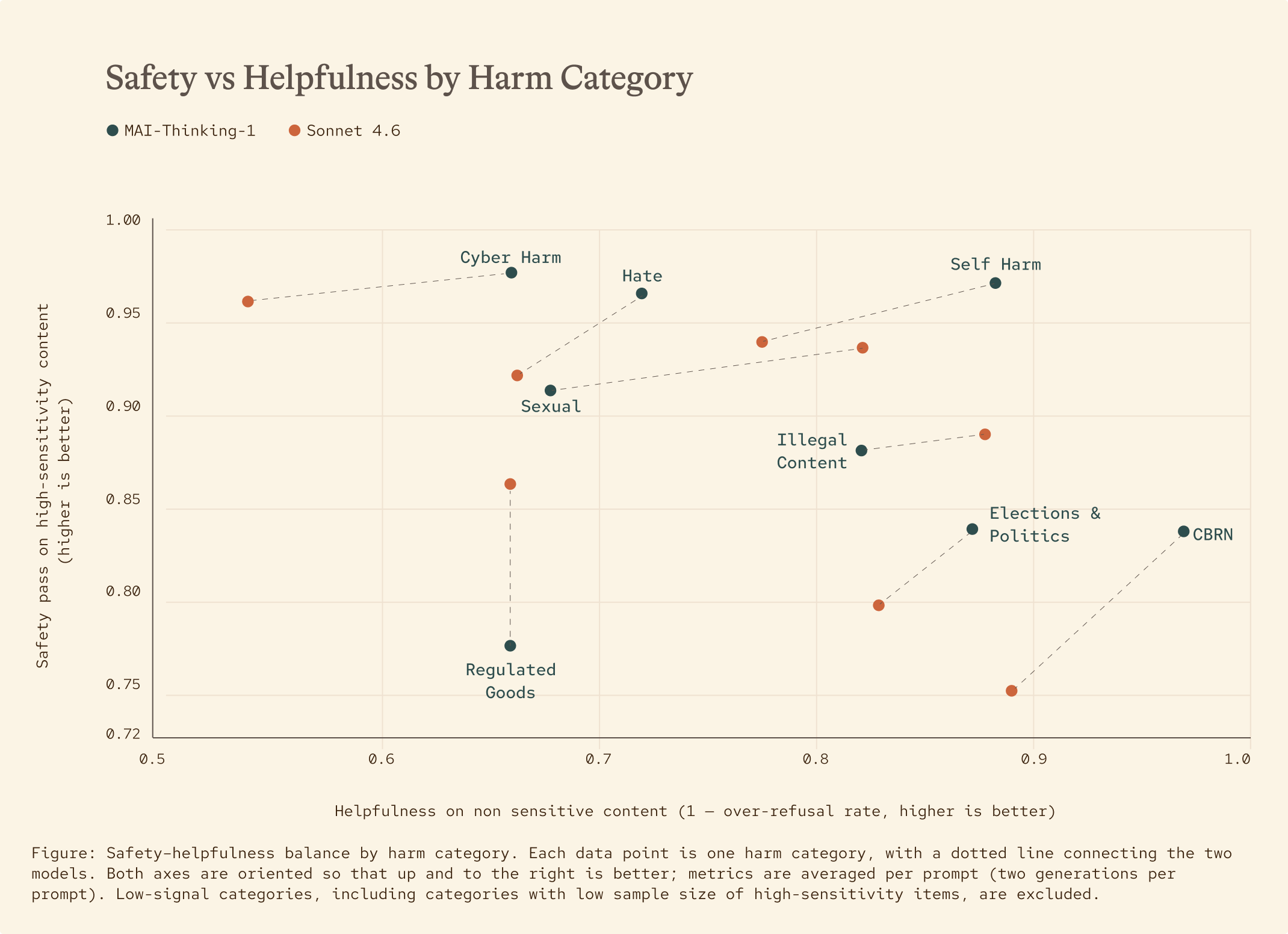
Microsoft took a distinctive approach to safety with MAI-Thinking-1. Rather than treating safety as a separate layer bolted on after training, the team integrated safety rewards directly into the same reinforcement learning loop used for capability improvements. In other words, safety is part of the hill-climbing process itself.
The goal is to balance two objectives that often conflict: refusing genuinely harmful requests while avoiding unnecessary refusals of legitimate ones. Microsoft frames both unsafe compliance and unnecessary refusal as defects, weighted by the severity of potential harm. As a result, the model can maintain a strong safety bar on sensitive requests while remaining helpful on non-sensitive content.
This philosophy aligns with Microsoft’s broader vision of “Humanist Superintelligence” — the idea that advanced AI capabilities should serve people and organizations rather than replace them. Models should remain subordinate technologies under human control, with the goal of upholding human autonomy.
How to Access Microsoft MAI-Thinking-1
As of late June 2026, Microsoft MAI-Thinking-1 is available in private preview through Microsoft Foundry. A public preview on the MAI Playground is expected soon. All MAI models come with enterprise-grade security and compliance protections built in.
For developers, the model is compatible with the Chat Completions API, which means integration into existing applications and workflows should be straightforward. Moreover, all MAI models will be available through Azure AI Foundry, Microsoft’s centralized platform for discovering, deploying, and managing AI models in production.
Pricing details have not been officially published yet for MAI-Thinking-1. However, Microsoft has emphasized that the model’s smaller inference footprint is designed to make it significantly more cost-effective than competing models of similar capability, particularly for high-volume enterprise workloads.
What Microsoft MAI-Thinking-1 Means for Microsoft 365
While Microsoft has not yet announced specific integrations between MAI-Thinking-1 and Microsoft 365 Copilot, the implications are clear. Microsoft now has the capability to power its own Copilot experiences with in-house models rather than relying exclusively on OpenAI. This could lead to several outcomes over time.
For instance, Copilot Cowork, which recently reached general availability, handles complex multi-step tasks that span multiple applications. These agentic workloads are exactly the type of use case where MAI-Thinking-1’s reasoning capabilities and cost efficiency could provide significant value. Similarly, Microsoft Scout, the always-on Autopilot agent, could benefit from a model optimized for long-running, context-heavy tasks.
Furthermore, MAI-Code-1-Flash is already integrated into GitHub Copilot and VS Code, demonstrating that Microsoft is actively deploying MAI models into production products. It is reasonable to expect that MAI-Thinking-1 and future MAI models will eventually power more Microsoft 365 experiences as well.
Key Takeaways for IT Admins and Decision Makers
Microsoft MAI-Thinking-1 is not just another model announcement. It signals a fundamental shift in Microsoft’s AI strategy. Here are the key takeaways:
- Microsoft is building AI independence. With seven in-house models trained without third-party distillation, Microsoft is reducing its reliance on OpenAI for core AI capabilities.
- Enterprise data provenance is a priority. Clean, commercially licensed training data means organizations can adopt MAI models with greater confidence in compliance and IP safety.
- Cost efficiency is a competitive lever. The 35B-active MoE architecture delivers premium performance at a mid-weight price, making advanced AI more accessible for large-scale deployments.
- The Hill-Climbing Machine approach means continuous improvement. This is not a one-time release but a system designed to produce better models over time.
- Expect deeper product integration. With MAI-Code-1-Flash already in GitHub Copilot, more MAI models will likely power Microsoft 365 and Azure services in the coming months.
For organizations already invested in the Microsoft ecosystem, keeping an eye on the MAI model family is essential. As these models mature and move from preview to general availability, they could reshape how Copilot, Azure AI, and the broader Microsoft 365 platform deliver intelligent capabilities.
Want to stay up to date on Microsoft 365, Copilot, and enterprise AI developments? Explore more articles on SharePoint Monkey for practical guides, breaking news, and deep dives into the technologies that matter most to IT professionals.
Sources
- Introducing MAI-Thinking-1 — Microsoft AI
- Building a Hill-Climbing Machine: Launching Seven New MAI Models — Microsoft AI
- Introducing Microsoft Scout — Microsoft 365 Blog
- Microsoft Build 2026: Be Yourself at Work — Official Microsoft Blog
- Microsoft Build 2026: MAI-Thinking-1 Is First In-House Reasoning Model — TechTimes
- MAI-Thinking-1 vs Claude, GPT-5.5 & Gemini — Lushbinary
- New MAI Models in Microsoft Foundry — Microsoft Tech Community
- Microsoft MAI Models Explained — MindStudio
Discover more from SharePoint Monkey
Subscribe to get the latest posts sent to your email.