Claude Fable 5 is back online. Anthropic’s flagship model spent two weeks locked out of reach after a US export control order suspended it for every user worldwide, and its return on July 1 arrived alongside a fresh safety classifier, an industry-wide jailbreak framework, and a new set of Claude Enterprise admin controls. For Microsoft 365 and Azure administrators who already juggle Copilot, Purview, and multi-vendor AI policy, the Claude Fable 5 saga is a preview of what governing frontier AI will look like going forward.
The story matters beyond Anthropic’s customer base. Claude models now run inside Microsoft Foundry and power parts of Microsoft 365 Copilot Cowork, so a two-week suspension of Fable 5 rippled into tenants that never signed up for Claude directly. Consequently, IT and security leaders have a new case study in how quickly a government directive can pull a frontier model out of production, and what a responsible vendor does to bring it back.
What Happened: Claude Fable 5’s Two-Week Disappearance
Anthropic released Claude Fable 5 and its more powerful sibling, Mythos 5, on June 9. Fable 5 shipped with heavy safeguards for general use, while Mythos 5 stayed restricted to a small group of trusted partners doing defensive cybersecurity work under Anthropic’s Project Glasswing program. Just three days later, on June 12, the US government applied export controls to both models, requiring Anthropic to block access for foreign nationals immediately.
Because Anthropic had no reliable way to verify user nationality in real time, it suspended Fable 5 and Mythos 5 for everyone rather than risk violating the order. The trigger, according to Anthropic, was a report from Amazon researchers showing a way to prompt Fable 5 into identifying software vulnerabilities and, in one case, producing exploit code. That finding set off ten weeks of coordination between Anthropic, the US government, and Glasswing partners including Amazon, Microsoft, and Google.
Why the Government Stepped In on Claude Fable 5
Anthropic’s own testing afterward found the reported bypass was not actually a unique Fable 5 problem. Less capable models, including Claude Opus 4.8, GPT-5.5, and Kimi K2.7, could identify the same vulnerabilities. Every model Anthropic tested, from Claude Haiku 4.5 up through GPT-5.5, could reproduce the single exploit demonstration in the report. In other words, the behavior sat in a genuinely gray zone: a borderline case that Fable 5’s safety classifiers should arguably have caught, but one that only involved routine defensive security research rather than a novel offensive capability.
Even so, Anthropic treated the report seriously. Working with government partners, the company trained an improved safety classifier specifically targeting the behavior described in the Amazon report. That new classifier now blocks the technique in more than 99% of cases, according to Anthropic, and researchers at the Department of Commerce’s Center for AI Standards and Innovation reviewed both the old and new safeguards and called them “extraordinarily strong.”
How Claude Fable 5’s Safety Margin Actually Works
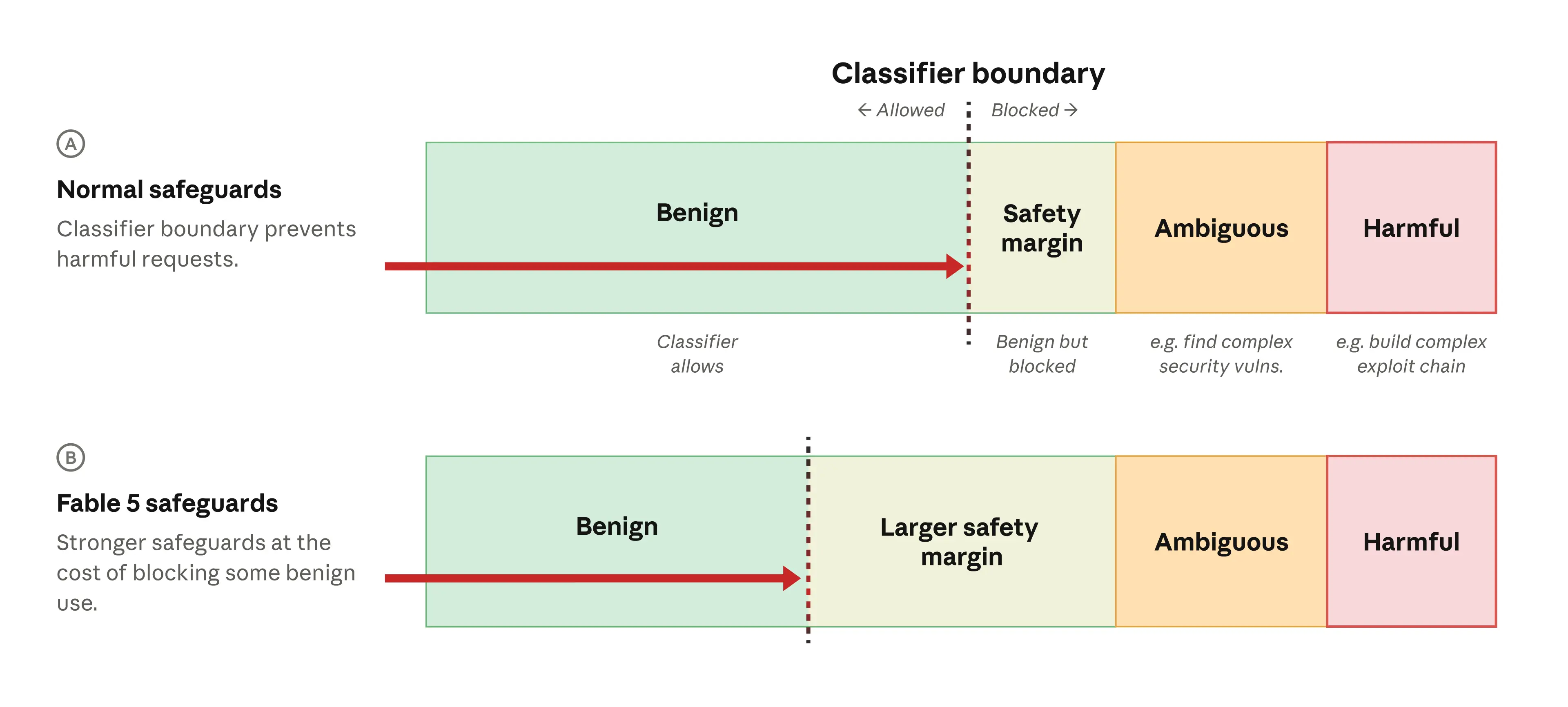
Anthropic’s explanation of its safeguards offers a useful mental model for any admin evaluating AI vendor risk. Claude Fable 5 relies on layered defenses: training the model to decline dangerous requests, real-time classifiers that watch for harmful cybersecurity patterns during generation, and account-level review that looks across conversations for signs of persistent misuse rather than a single suspicious prompt.
Crucially, Anthropic deliberately set Fable 5’s classifiers to trigger on requests that are probably benign but carry some small chance of harm. The company calls this a “safety margin,” and for Fable 5, that margin is larger than in any previous Anthropic launch. As a result, users occasionally run into refusals on legitimate coding or debugging tasks. Anthropic frames that tradeoff as intentional: better to over-block a few reasonable requests than under-block a genuinely dangerous one.
- Model-level training: Fable 5 is trained to refuse prohibited cyber assistance, even when a user tries to disguise intent.
- Real-time classifiers: Smaller models watch generation as it happens and can pause a response for deeper review.
- Account-level signals: Anthropic can look across a user’s history to separate one-off dual-use questions from a sustained pattern of misuse.
- Continuous red-teaming: Anthropic says it devoted more than 700,000 A100-equivalent GPU hours to automated red-teaming aimed at universal jailbreaks.
A New Industry Standard for Scoring AI Jailbreaks
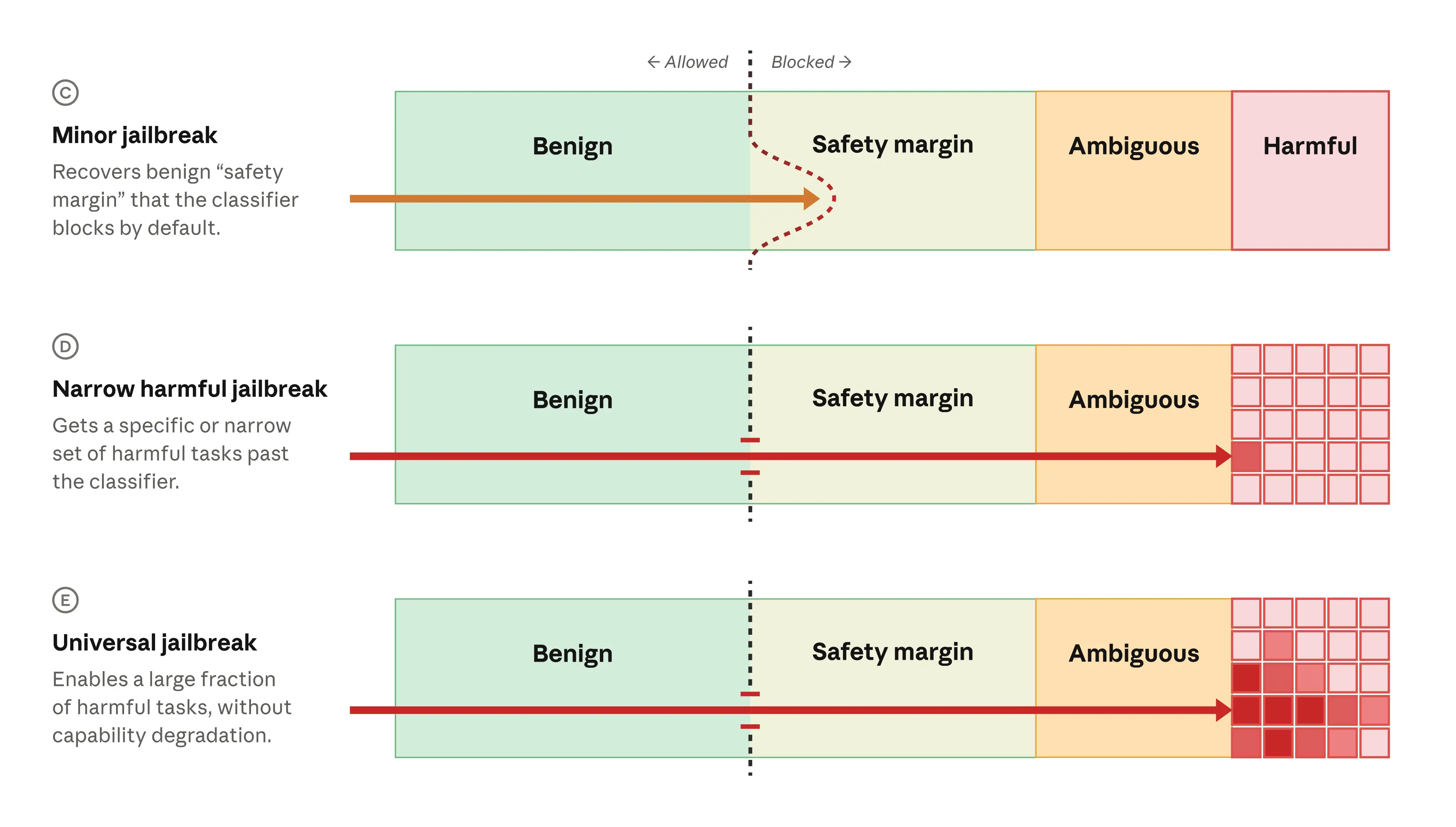
Perhaps the most consequential piece of this story is not Fable 5 itself but what Anthropic is proposing next. Together with Amazon, Microsoft, Google, and other Glasswing partners, Anthropic is drafting a shared industry framework for scoring the severity of AI jailbreaks, similar in spirit to the Common Vulnerability Scoring System that security teams already use for software bugs.
The proposed framework scores a jailbreak on four criteria: how much capability it hands an attacker beyond existing tools, how many distinct offensive tasks it unlocks, how easy it is to weaponize, and how discoverable the technique already is. A jailbreak that scores high across all four would trigger an immediate response, including preliminary mitigations as soon as Anthropic confirms severity. The company also says it is standing up 24/7 monitoring of key jailbreak submission channels and launching a HackerOne bug-bounty program specifically for cyber jailbreaks in Fable 5.
Claude Fable 5 Is Back: What’s Different Now
As of July 1, Claude Fable 5 is available again to users globally across the Claude Platform, Claude.ai, Claude Code, and Claude Cowork. For Pro, Max, Team, and premium Enterprise plans, Anthropic is including Fable 5 for up to 50% of weekly usage limits through July 7, after which access shifts to usage credits. Standard Enterprise seats have no included Fable 5 allowance by default and need usage credits enabled for their users to reach it at all.
Mythos 5 access has also been restored for a set of US organizations following government approval on June 26, and Anthropic says it continues to expand the Glasswing program to additional domestic and international partners. Meanwhile, re-enabling Fable 5 on AWS, Google Cloud, and Microsoft Foundry is still in progress, so administrators who consume Claude through those platforms should check current availability before assuming parity with Claude’s first-party surfaces.
New Claude Enterprise Admin Controls Arrive Alongside the Return
Notably, Anthropic used this moment to also ship a broader set of Claude Enterprise admin tools, announced July 2. The updated admin analytics dashboard now breaks down usage and cost by group and by user, showing artifacts created, files edited, and skills or connectors used right next to their associated cost. Admins can filter by existing SCIM groups, so the view matches the org chart IT already manages.
Spend-threshold alerts now notify admins at 75% and 90% of an org-level limit, giving teams time to raise a cap before anyone gets blocked mid-task. Users themselves get notified at 75% and 95% of their own limits and can request an increase without leaving Claude. Additionally, new model-level entitlements let admins decide which Claude model a conversation starts with by default across chat, Cowork, and Claude Code, so routine work does not automatically default to the most expensive option. All of this data is also available through an Analytics API, so finance and security teams can pull Claude usage into tools like Datadog Cloud Cost Management or CloudZero alongside the rest of their cloud spend.
- Usage and cost by group or user, filterable by existing SCIM groups
- Spend-threshold alerts at 75% and 90% for admins, 75% and 95% for users
- Model defaults and entitlements by role or organization-wide
- Analytics API for exporting Claude usage into existing FinOps tooling
- Claude Code value tab estimating productivity lift and cost per commit

What This Means for Microsoft 365 and Azure Admins
Microsoft 365 admins already know Claude is not an outside player anymore. Anthropic’s models now run inside Microsoft Foundry, and Microsoft 365 Copilot Cowork uses Claude models such as Opus 4.8 and Sonnet 4.6 alongside GPT-5.5 for long-running, multi-step work. That means the Fable 5 suspension, even though it targeted Anthropic’s own consumer and API surfaces first, is directly relevant to any tenant that leans on Cowork’s multi-model routing or licenses Claude for Microsoft 365 features inside Word, Excel, PowerPoint, and Outlook.
For admins, the practical lesson is that model-level governance now needs to span vendors. A Microsoft 365 tenant that only tracks Copilot licensing and Purview policies is missing half the picture if it also routes work through Claude models via Foundry or Cowork. Anthropic’s new spend alerts, model entitlements, and Analytics API mirror the kind of controls Microsoft 365 admins already expect from Purview and the Microsoft 365 admin center, so the two ecosystems are converging on similar governance patterns even as they remain separate consoles to manage.

Key Takeaways for IT and Security Leaders
The Claude Fable 5 episode is a useful stress test of how frontier AI governance will work going forward, especially as the US government’s June 2 executive order on AI innovation and security pushes for closer pre-release coordination between labs and federal agencies. A few takeaways stand out for admins managing AI across Microsoft 365, Azure, and other platforms.
- Confirm whether your organization’s Claude access runs through Anthropic directly, Microsoft Foundry, AWS, or Google Cloud, since restoration timing has varied by platform.
- Review Enterprise plan tier and usage-credit settings now, since standard Enterprise seats need credits enabled before users can reach Fable 5 at all.
- Treat vendor jailbreak disclosures as seriously as software CVEs; the proposed industry severity framework may become a reporting standard worth tracking.
- Use the new Claude Enterprise spend alerts and model entitlements alongside existing Microsoft 365 Copilot governance controls, rather than treating each vendor’s console in isolation.
- Expect more government-coordinated release patterns for frontier models as the executive order framework matures, which could affect rollout timing for future Claude, GPT, and Gemini releases alike.
Ultimately, the return of Claude Fable 5 shows that even a well-resourced lab can lose access to its own flagship model overnight when export controls and safety disclosures collide. For Microsoft 365 and Azure administrators, the safest posture is treating every frontier model in the tenant, whether it arrives through Copilot, Foundry, or a direct Anthropic contract, as a governed asset with its own risk profile, not an assumed constant.
Keep checking SharePoint Monkey for ongoing coverage of how Microsoft 365, Copilot, and the wider AI ecosystem are reshaping enterprise IT governance.
Sources
- Anthropic: Redeploying Claude Fable 5
- Claude: Giving admins more visibility and control over Claude spend
- Al Jazeera: US lifts restrictions on Anthropic’s Fable and Mythos models
- Microsoft 365 Blog: Copilot Cowork is now generally available
- The White House: Promoting Advanced Artificial Intelligence Innovation and Security
Discover more from SharePoint Monkey
Subscribe to get the latest posts sent to your email.